Speaking up to survive: women against online violence
By Dilyana Stoyanova
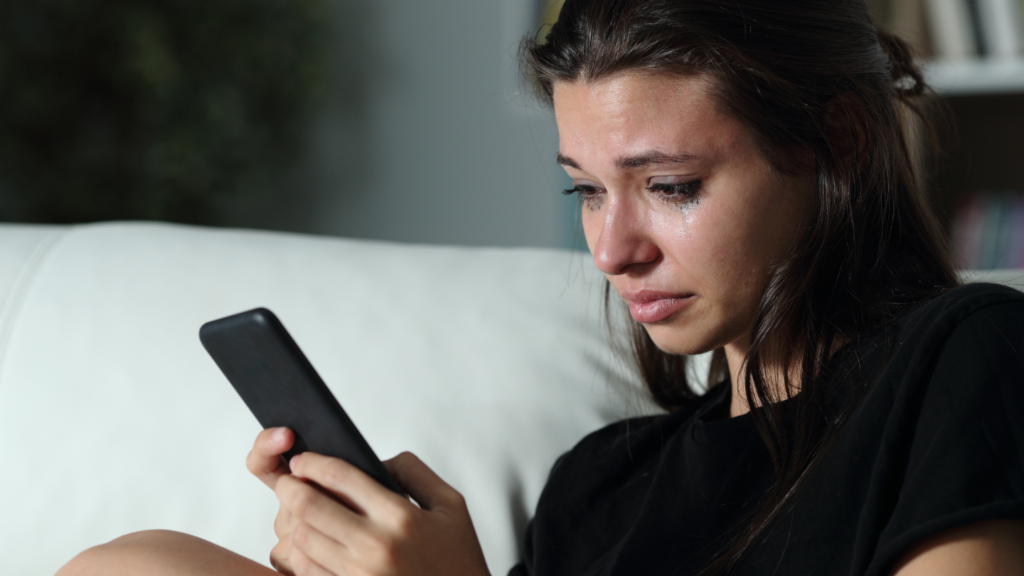
“The phone vibrates. I don’t know what to expect from the next message – an insult, a threat, blackmail… I prefer not to look, I don’t have the strength.
Elena* is one of the many women who come face to face with the dark side of the internet. As often happens, it all starts with “real” life and one… photo. Taken in seconds, sent in just as many seconds and has been haunting her for months. Elena’s former intimate partner uses the photo content as a kind of revenge for the breakup she initiated. The photo “ends up” on the Telegram platform, where it is the subject of obscene comments. Elena learns about what is happening from an acquaintance.
Unfortunately, such a case is not unprecedented – quite a few Telegram groups function precisely for the purpose of publicly humiliating women and distributing sexual content.
“I felt not only betrayed and abused, but also threatened. He knew who I was, where I lived, what I did… I was afraid to go to work or leave the house. I thought everyone had seen this photo and would recognize me.”
Elena never gathered the strength to file a report with the police or the Bulgarian Anti-Corruption Bureau. Today, she has to visit a psychologist – a service that is not covered by the Health Insurance Fund.
The invisible hate behind the screen
Online harassment is one of the most invisible, yet widespread forms of violence. In Bulgaria, it affects not only public figures, but also “ordinary” users who fall into the field of group hate. Women turn out to be one of the most vulnerable groups in the digital space. Just like Elena.
One in ten women in the European Union has been subjected to harassment in the digital world, according to a study by the European Union Agency from 2014. And despite the increasing use of social networks and the lower age limit of users, we do not have new data on the current picture. However, it is clear that there is clearly a problem. Ten years after this study – in 2024 – the European Parliament adopted the first-ever EU rules to combat violence against women. With this, European legislation puts a clear focus on cyberviolence – one of the fastest growing risks in the digital age. The new rules oblige member states to criminalize forms of online harassment, such as cyberstalking, cyberbullying, online sexual harassment, as well as the distribution of intimate images without consent. The aim is not only to prosecute perpetrators more severely, but also to support victims more effectively through specialized services and clear protection mechanisms. Although the directive sets a clear European standard, there remains a risk that Bulgaria will fall behind in its implementation. Our country already has a history of delays in transposing important European acts, especially in the field of digital security and personal data protection. The lack of sufficient resources, the slow legislative procedure and weak coordination between institutions may lead to measures against cyberbullying being introduced formally and with a delay. This means that while in other countries victims of online harassment will receive faster and more effective protection, in Bulgaria we risk being left with only promises on paper for a long time.
“On the front line”
In the absence of sufficiently fast institutional mechanisms, more and more people in Bulgaria are finding support in Facebook groups for mutual aid.
The largest active online community for help and advice for victims of domestic violence is “You are not alone – together against violence against women”. It was born in 2018, as a natural continuation of a campaign by the website “Girls from the City” in connection with the refusal to ratify the Istanbul Convention. The group is supported by the “Будителките” Foundation.
“The group has become not only a place where people can vent their pain, but also a digital hotline for mutual aid,” says Levena Lazarova, managing director and the person behind the initiative, in a special interview. It has over 10,000 members who publish their personal stories daily – often painful to read. Administrators – volunteers – are responsible for the “care” of the group members, who are on duty so that there is always someone “on line” with fast, timely and up-to-date information about emergency centers, legal aid, protection, etc. The volunteers themselves also receive the necessary psychological support to assist others as adequately as possible.
On the other side of the barricade
Although the group is in the “Confidential” mode, the administrators say that they constantly have to make efforts to maintain its security. The group finds itself under the “surveillance” of people who are on the other side of the barricade – most often it is men with restraining orders, partners with domestic violence cases… How do they act? Like a game of traitors. The people in question often try to join through fake profiles or through impersonators. Their online presence is easily recognizable – they are aggressive in the comments section and violate the group’s rules, some of them even make threats to moderators and administrators.
Violence in numbers

A survey was conducted among the group members on the needs and attitudes of victims of domestic violence and their children, entitled “Hear My Voice”. 94% of the participants are women, 6% are men. Although the survey is not representative, it clearly outlines the profile of those most affected, but it also reminds us that violence also affects men – albeit on a significantly smaller scale. The largest group of victims are between the ages of 25 and 46 – a time when families are usually created and children are raised, which makes vulnerability even greater.
The survey also reveals how actively support is sought online – 75% of members participate in the discussions, with each post collecting an average of 12 comments and 49 reactions. Behind these numbers are real stories – of fear, seeking help and the need for understanding. The administrators of the group from the “Buditelkite” Foundation join an average of 20 times a day to respond to signals, refer to institutions or simply listen.
All this clearly shows that violence is not an isolated case or a “foreign” problem – it is all around us. Online groups become an emergency first aid when institutions fail to react quickly enough or people are not clear on how to act.
When the Internet becomes a refuge
Another extremely active Facebook community is “without (Dangerous) Relationships”. It has over 20 thousand members who post personal stories every day. The group does not lack humorous stories and a “meme element”, but the main focus is precisely the creation of a safe online and offline space for everyone. “Young women often seek advice for their first serious relationships, while more mature ones struggle with issues around divorce, infidelity or complex family situations”, says Alex Vangelov, administrator and activist. He observes a certain trend in the manifestations of online violence.
“For young women, bullying often focuses on appearance and conforming to beauty standards. Their sexual behavior is also targeted, with them being called “too easy” or “too conservative.” With older women, I see bullying take the form of attacks for expressing opinions on social or political issues, as well as the devaluing of their professional experience with comments like “hysterical feminist.” Also judging their motherhood choices or marital status,” says Vangelov.
He has noticed that young women have a harder time setting boundaries online, while older women sometimes underestimate the impact of digital bullying. Therefore, he says, both groups need different strategies for protection.
The activism of the group participants reveals that many women are not just suffering from domestic violence — they also carry with them the feeling that they cannot share because they will be accused of being “crazy” or even “guilty” for their feelings. The group is a digital bridge between fear and support, between isolation and community. Those who come scared and disillusioned often find strength when they realize they are not alone — and that their reaction is normal. And when online threats turn into offline danger, that inner voice and community become crucial for women to find protection and safety.
Vangelov says that the biggest change is in women’s confidence: “They come scared, doubting themselves, thinking they are ‘crazy’ for what they are feeling. And when they see that other women, and men, have experienced the same thing, they literally turn around. They realize that their reaction is normal and that they are not alone.” The main challenge is to prevent the group from becoming an “echo chamber” against men in general. And administrators must also be careful to maintain a balance, says Alex Vangelov.
Internet Therapy
In the modern digital age, online space is starting to play an increasingly important role not only for communication and information, but also for psychological support. Internet therapy and online support groups are becoming an important resource for women who are facing violence or harassment – a place where they can share their experiences and receive emotional support. Of course, online help does not take over the functions of professional therapy, but it provides perspective, comfort and a sense of community, which is sometimes the first step towards recovery.
Online and offline are not two separate, different worlds – they are one connected space that we inhabit. Threats on the Internet often escalate into physical violence, and what is experienced in reality continues into cyberbullying. Therefore, efforts to protect women cannot be limited to just one sphere – a comprehensive understanding and synchronized mechanisms are needed to guarantee security and support both online and offline.
With the advent of artificial intelligence, new risks are emerging – disinformation, fake profiles, automated distribution of intimate images. In this context, the role of groups like “You Are Not Alone” and “Safe Connections” becomes even more significant. Believing in community and mutual support, women find a way to turn fear into strength and anger into motivation for change. At the end of the day, small but important victories remain – a woman who smiles again, shares her experiences and realizes that she is not alone. This shows that the fight against cyberbullying is not just an individual issue – it is a common cause that requires solidarity, education and active protection of all who are vulnerable in the digital space. Because every educational initiative and every protected woman brings closer the moment when the online space can be safe. For you, for me, for Elena. For everyone.
*Name has been changed for safety reasons.
Funded by the OPEN SPACE Foundation (OSF) project “Youth against disinformation”, implemented in partnership with the Association of European Journalists in Bulgaria (AEJ-Bulgaria), with the support of the British Council in Bulgaria. However, the views and opinions expressed are entirely those of their author(s) and do not necessarily reflect the views and opinions of OSF, AEJ and the British Council in Bulgaria. Neither OSF, AEJ nor the British Council in Bulgaria are responsible for them.